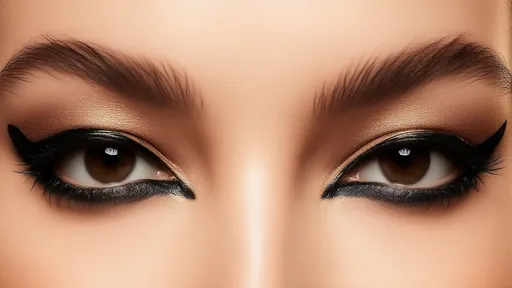
For years, my relationship with winged eyeliner was a tragic comedy of errors. I'd watch those flawless makeup tutorials where artists would effortlessly glide a liquid liner across their lids, creating a sharp, symmetrical flick that could probably cut glass. Meanwhile, my own attempts looked more like a toddler had gotten hold of a Sharpie during an earthquake. The uneven lines, the smudged corners, the constant frustration of one eye looking decent while the other resembled a sad, droopy comma—sound familiar? If you've ever stood in front of your mirror, liner in hand, feeling utterly defeated, you're not alone. This isn't just about makeup; it's about conquering a beauty challenge that has humbled many of us.
The Game-Changing Realization: It's All About the Tools
My first breakthrough came when I stopped blaming my shaky hands and started questioning my tools. I'd been using the wrong type of liner for my skill level and eye shape. Gel pots with brushes require serious brush control, while felt-tip liners can dry out quickly and skip across the lid. After testing what felt like every formula on the market, I discovered that a fine-tipped brush pen liner with flexible bristles gave me the control I desperately needed. The NYX Epic Ink Liner became my holy grail—it's pigmented, doesn't budge, and the brush tip is precise enough to create both thin lines and dramatic wings. The right tool doesn't just make the process easier; it transforms your entire approach.
The Foundation You're Probably Skipping: Eye Primer Matters
Here's something I learned the hard way: even the best liner will smudge if your eyelids are oily or unprepared. I used to think eye primer was an unnecessary step, until I noticed my perfect wings turning into blurry messes within hours. Applying a thin layer of primer like the Urban Decay Eyeshadow Primer Potion creates a smooth, matte canvas that helps your liner adhere better and last all day. This small addition to my routine made a dramatic difference in how crisp my wings looked hours after application. It also prevents those annoying transfer marks on your brow bone that can ruin your hard work.
The Positioning Secret That Changed Everything
For years, I'd try to draw my wing by extending the line from the corner of my eye upward. This method consistently resulted in uneven, droopy flicks that never matched. The revelation came when I started positioning the wing based on my lower lash line instead. Here's the technique that finally worked: imagine extending your lower lash line upward toward the end of your eyebrow. That invisible line is where your wing should follow. Place a small dot where you want the wing to end—this becomes your target. Then, starting from that dot, draw the outer edge of your wing back toward your lash line. This reverse approach gives you so much more control over the angle and length.
The Connect-the-Dots Method for Perfect Symmetry
Getting both eyes to match used to be my biggest challenge until I developed this connect-the-dots technique. Instead of trying to draw one continuous line, I create three strategic dots on each eye. The first dot marks where I want the wing to end (using the lower lash line method). The second dot is placed where the wing will connect to my upper lash line—about a third of the way in from the outer corner. The third dot sits in the middle of what will become the wing's curve. Once all dots are placed on both eyes, I step back from the mirror to check for symmetry before connecting them. This might sound tedious, but it eliminates the guesswork and ensures both eyes get the same shape and angle.
Mastering the Flick: The Tape Trick and Beyond
If you're still struggling with getting that sharp, clean edge, don't be afraid to use guides. The classic tape trick works wonders—place a small piece of Scotch tape from the outer corner of your eye toward the end of your eyebrow. Use the tape's edge as a stencil for your wing. For those who find tape too harsh on their skin, try using a business card or the edge of a makeup palette. Another pro tip: rest your elbow on a stable surface while applying liner. This minimizes hand tremors and gives you much steadier control. Remember, even makeup artists use these tricks—there's no shame in getting a little help.
Fixing Mistakes Without Starting Over: The Cotton Swab Savior
The Psychology of Practice: Embracing the Process
What finally made winged liner click for me wasn't just technical knowledge—it was shifting my mindset. I stopped expecting perfection on the first try and started viewing each attempt as practice. I'd dedicate 10 minutes each night before washing my face to experiment with different techniques without the pressure of needing to wear it out. This took away the frustration and made the process enjoyable. The truth is, muscle memory develops over time. After about three weeks of consistent practice, my hands naturally learned the motion, and what once took 15 minutes of intense concentration now takes me about 60 seconds. The learning curve is real, but so is the payoff.
Beyond the Basics: Adapting to Your Eye Shape
Once you've mastered the standard winged liner, you might discover that certain adjustments work better for your specific eye shape. Those with hooded eyes often benefit from creating the wing with eyes open rather than closed, ensuring the design remains visible. For monolids, a thinner line that gradually thickens toward the outer corner tends to work beautifully. Deep-set eyes can handle more dramatic, thicker wings without overwhelming the space. The beauty of mastering the basic technique is that it gives you the foundation to experiment and customize based on what enhances your unique features.
The Confidence That Comes With Mastery
There's something incredibly empowering about finally conquering a skill that once felt impossible. That moment when you look in the mirror and see two sharp, symmetrical wings staring back at you—it's more than just good makeup. It's a reminder that persistence pays off, that practice leads to progress, and that you're capable of mastering things that initially seem daunting. The confidence boost extends beyond your makeup routine—it's a small victory that reminds you of your own capacity for growth and improvement.
Winged liner perfection didn't happen for me overnight, and it probably won't for you either—and that's completely okay. The journey itself teaches patience, precision, and the value of not giving up when something challenges you. Start with the right tools, embrace the connect-the-dots method, practice without pressure, and remember that even the makeup artists you admire once struggled with their first attempts. Your perfect wing is waiting—all it takes is the willingness to try, adjust, and try again.

By David Anderson/Nov 18, 2025

By Grace Cox/Nov 18, 2025

By David Anderson/Nov 18, 2025

By William Miller/Nov 18, 2025

By Rebecca Stewart/Nov 18, 2025

By Sophia Lewis/Nov 18, 2025

By Rebecca Stewart/Nov 18, 2025

By Ryan Martin/Nov 18, 2025

By Victoria Gonzalez/Nov 18, 2025
By Lily Simpson/Nov 18, 2025

By Sarah Davis/Nov 18, 2025

By Emily Johnson/Nov 18, 2025

By Emma Thompson/Nov 18, 2025

By Megan Clark/Nov 18, 2025

By Daniel Scott/Nov 18, 2025

By Noah Bell/Nov 18, 2025

By Noah Bell/Nov 18, 2025

By Grace Cox/Nov 18, 2025

By James Moore/Nov 18, 2025
By Olivia Reed/Nov 18, 2025